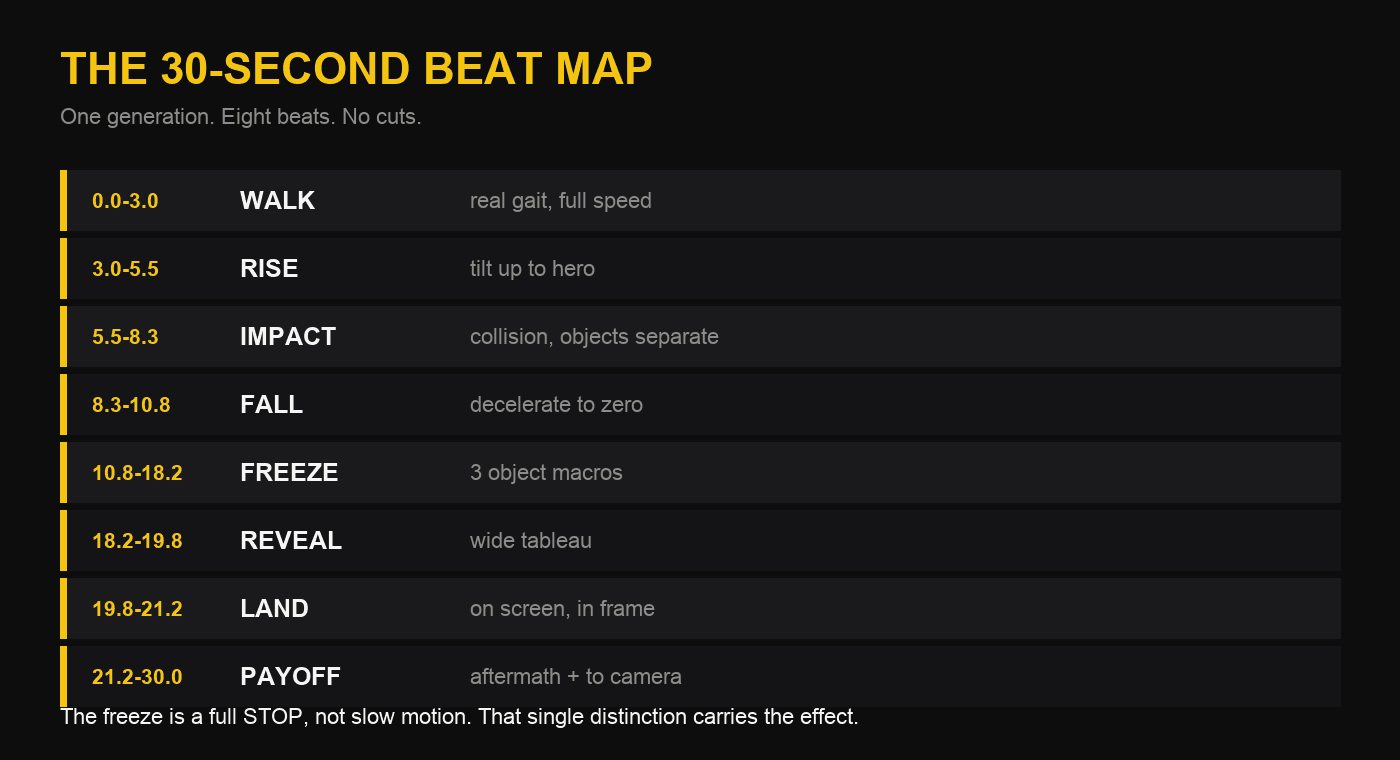
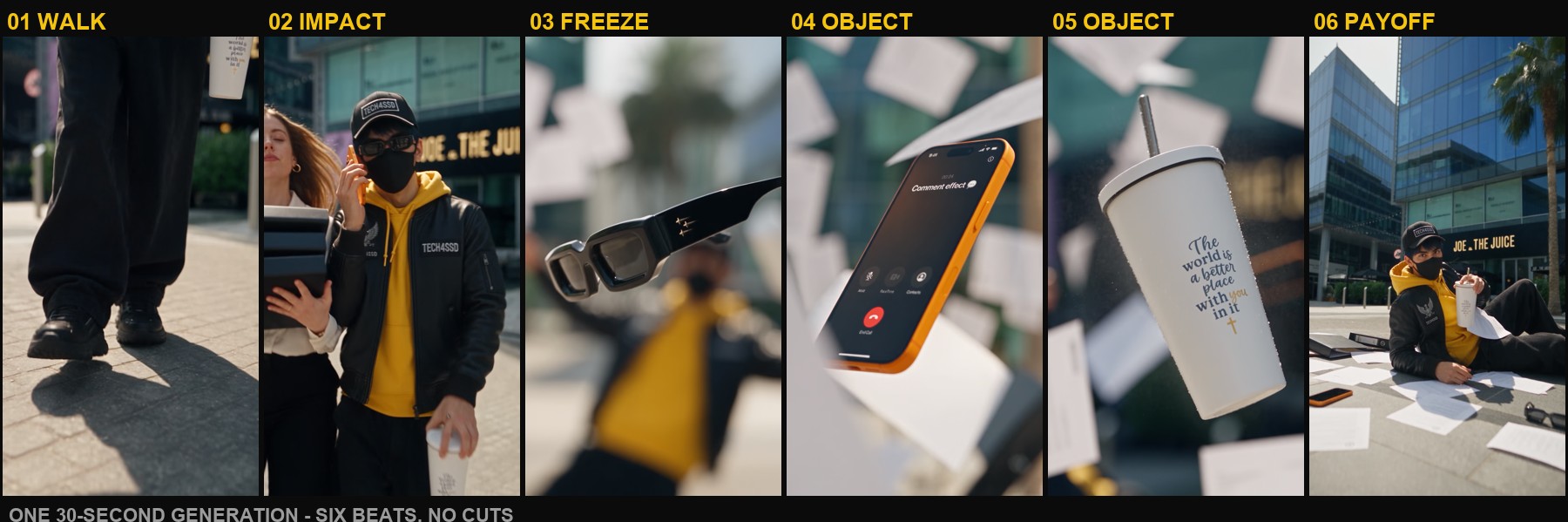
This is the long-form version: thirty seconds, three separate frozen object beats, a full wide reveal, and a to-camera ending. Use it when you want a film rather than a fifteen-second hook.
It is built as seven labelled sections, in this order, because the model reads structure better than it reads storytelling, and because when something goes wrong you will know exactly which section to edit:
1. FORMAT AND CAMERA BODY - aspect, resolution, duration, take count, film stock language.
2. CAMERA BEHAVIOUR - how the camera moves. Explained in step 8.
3. REFERENCE LOCKS - one paragraph per reference, exhaustively described.
4. TIMED BEATS - every beat with a start and end timestamp. The freeze is explained in step 7, the body mechanics in step 9.
5. LIGHTING - time of day, direction, bounce, and a demand for consistency across the take.
6. COLOUR - the palette, and which single colour is allowed to be the most saturated thing in frame.
7. RULES and AVOID - physics constraints, then a blunt list of everything you don't want.
Fill in every bracket. The wardrobe description is the one people rush, and it is the one that decides whether your character survives thirty seconds. Write it out in full even though the character sheet is already attached.
Most video models cap the prompt around ten thousand characters. This lands close to that ceiling once your brackets are filled, so if you need room, trim LIGHTING and COLOUR first. Never trim the CAMERA section or the AVOID list.
Vertical 9:16, 1080x1920, 30 seconds, ONE continuous take, no cuts. Photorealistic live-action. [CAMERA BODY] with [LENS SET], [WIDE FOCAL] wide and [MACRO FOCAL] macro. [TIME OF DAY].

CAMERA - CONTROLLED HANDHELD, SUBJECT ALWAYS IN FRAME. The camera is handheld by an experienced documentary operator with a steady grip. It carries a constant fine tremor and a gentle breathing drift so it never feels robotic, and it bobs softly with the operator's footsteps while walking backward - but every move is SMALL, SMOOTH AND CONTROLLED. Absolutely no whip pans, no violent swings, no sudden jerks, no fast camera flicks, no smeared motion-blur transitions. THE MAIN SUBJECT MUST REMAIN VISIBLE INSIDE THE FRAME IN EVERY SINGLE FRAME OF THE FILM FROM FIRST TO LAST. The camera never swings off them, never loses them, never leaves them behind, never shows an empty location without them, and never lets them exit the edge of frame. If they move, the camera follows calmly and keeps them composed in shot. Natural 180-degree motion blur. Shallow depth of field.

CHARACTER LOCK <<<image_1>>>: [exhaustive wardrobe, every garment and patch and its position, hex colours].

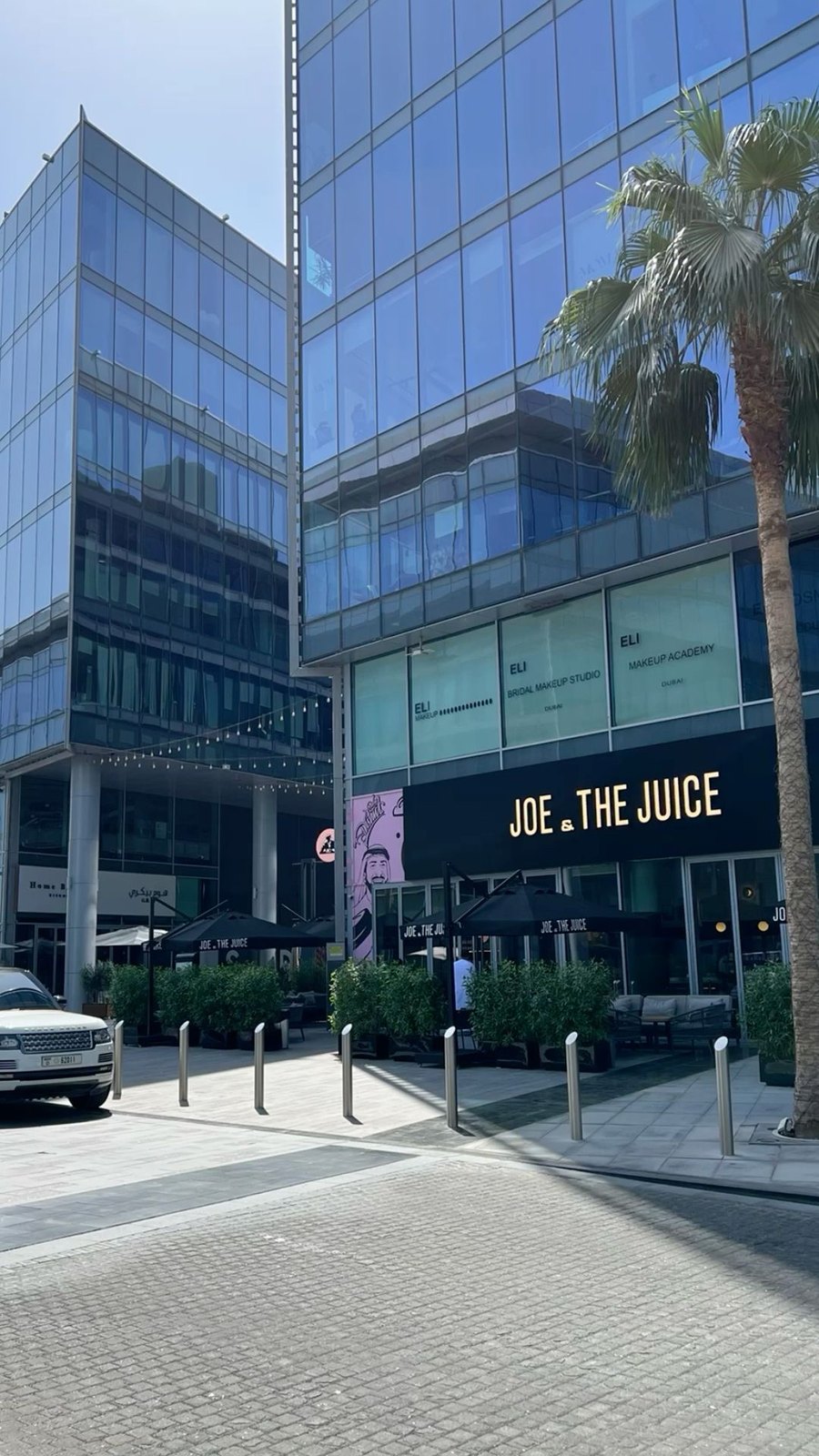
ENVIRONMENT <<<image_2>>>: [the location - list the buildings, signage, street furniture, planting, ground surface]. Use for architecture and geography only; relight per the LIGHTING block.

WORN OBJECT <<<image_3>>>: worn by the subject. [material, shape, colour, finish]. On [specific surface, e.g. the outer temple arm], [your existing mark], and IMMEDIATELY RIGHT of it, engraved in the same [metal/colour], sharp and fully legible: [YOUR WORDMARK]. Same tone and engraving depth. Fine luxury engraving, not a print or sticker.

SCREEN OBJECT <<<image_4>>>: held in [which hand / at which ear]. [device description and case colour with hex]. Screen on, showing [the narrative beat - a call, a message, a timer].

SURVIVOR OBJECT <<<image_5>>>: in [which hand]. [material, colour, closure, artwork]. [State whether it is sealed and whether anything can spill].

0.0-3.0s - THE WALK, REAL SPEED. Full speed, no slow motion. Camera at ankle height, operator walking backward in a crouch, frame bobbing gently. The gait is anatomically correct at natural pace, about two steps per second: HEEL STRIKES FIRST, the foot rolls through the arch, the heel lifts, the toe pushes off. Full stride, real ground clearance, real distance covered. No shuffling, no gliding, no skating feet. Hips sway, weight transfers over each planted leg.

3.0-5.5s - THE RISE. The operator lifts the camera by hand up the body in an uneven, wobbly climb, not a smooth crane, settling chest-up on the face. The subject is mid-[activity] and does not look at camera.

5.5-7.2s - APPROACH. [The second person] hurries the other way, arms full of [scatterable material], not watching where they are going.

7.2-8.3s - IMPACT. They collide shoulder-first, hard. The camera reacts with a small firm jolt and immediately recovers - it does NOT swing away and does NOT lose the subject. [Scatterable material] erupts. All three hero objects separate visibly from the subject on believable arcs.

8.3-10.0s - A REAL FALL, NOT A STUNT. Knocked backward off balance. NOT a somersault, NOT a backward roll, NOT legs flipping over the head, no acrobatics. One staggering half-step back, the trailing foot failing to find the ground, the torso tipping past recovery, one arm swinging back on reflex. Clumsy, heavy, unglamorous. Motion decelerates through this beat.

10.0-10.8s - TIME STOPS. Deceleration to ABSOLUTE ZERO. Not slow motion - a total stop.

10.8-13.4s - FROZEN, WORN OBJECT. The entire world is perfectly static - every person and object at absolute standstill, zero movement, zero drift, zero descent, zero rotation. The subject's pose is identical at the start and end of this beat. ONLY THE CAMERA MOVES. Macro push toward the suspended [worn object]. CRITICAL: it DOES NOT ROTATE OR TURN during this beat; it holds one fixed orientation with the engraved surface facing the lens the whole time, so [your wordmark] stays square to camera and readable. A hard mirror-bright specular glint travels slowly across the surface, lighting each letter in sequence and blooming into a soft flare.

13.4-15.8s - FROZEN, SCREEN OBJECT. Still absolutely static, zero motion and zero rotation. Camera arcs gently through the frozen field and finds it: tilted, face to lens, screen legible. A glint sweeps the edge as the camera passes.

15.8-18.2s - FROZEN, SURVIVOR OBJECT. Still absolutely static, zero motion and zero rotation. Camera arcs on to it, [orientation], a halo of motionless [droplets/particles] around it. Artwork square to camera.

18.2-19.8s - THE REVEAL. Camera pulls back and rises smoothly into a wide of the whole frozen tableau. The subject stays centred in frame.

19.8-21.2s - SNAP BACK AND LAND, FULLY ON SCREEN. Full speed returns in one instant and gravity acts IMMEDIATELY. No hovering, no floating, no hanging horizontally, no gliding. THE LANDING ITSELF MUST BE SHOWN CLEARLY ON SCREEN with the whole body inside the frame and in focus. The camera holds through the entire impact and does not cut away or lose them. No roll, no flip: forearm and hip strike first, then shoulder blade, then back. One small heavy secondary bounce, then settle.

21.2-25.0s - AFTERMATH, ALIVE NOT FROZEN. Low angle at ground level. They lie still but are clearly a living body, never a mannequin: chest rising and falling, head rolling to one side, one knee drawing up, fingers flexing. [Scatterable material] keeps settling for several seconds. Their hand gropes out of frame, finds the [survivor object], pulls it in and raises it - intact, nothing lost. One slow approving nod.

25.0-27.5s - SITTING UP. They push onto one elbow, then sit, unhurried and unbothered.

27.5-30.0s - TO CAMERA, SQUARE TO THE LENS. They TURN THEIR WHOLE UPPER BODY AND HEAD TO FACE THE CAMERA DIRECTLY - front on, square to the lens, NOT in profile, NOT looking off to the side. They lift the [survivor object] a few inches toward camera and hold it, and hold the look, centred and steady, for the last two full seconds. Clean negative space across the upper third.

LIGHTING. [Time of day], CONSISTENT FROM FIRST FRAME TO LAST - sun angle and warmth must not change during the take. [Key direction], [shadow character], [rim light]. [What bounces fill into the shadows and what colour it is].

COLOUR. [Overall palette], deep blacks with retained detail, one warm accent - [YOUR BRAND COLOUR + HEX] - which must be the most saturated thing in any frame it appears in. Everything else desaturated. Filmic rolloff, halation on the speculars, fine 35mm grain.

RULES. The main subject is visible in frame in every frame. All three objects originate on the body and separate visibly at impact; nothing appears from off-screen, teleports or duplicates. During the frozen beats objects are anchored with absolutely zero motion and zero rotation; only the camera moves, and never touches the lens. One take, no cuts.

AVOID. Whip pans, fast camera swings, sudden jerks, smeared motion-blur camera moves, the camera losing the subject, any frame without the main subject in it, an empty location shot. The landing happening off screen. Hovering, floating or levitating; a body hanging horizontally in the air. Backward somersault, backward roll, legs over the head, acrobatics. Slow motion instead of a freeze; objects drifting or rotating during the freeze. Lying motionless like a mannequin. Ending in profile or facing away. Changing sun angle mid-shot. Text overlays, captions, watermarks, UI graphics. Extra limbs, warped hands, morphing or duplicated objects, crowds looking at the lens.

 ChatGPT or any image model (character sheet)